

You did the hard part. You found the right people, built a list, got their contact details. And then you sat down to write the message and everything slowed down.
What do you actually say?
Most podcasters at this point send something generic. “Hi, I host a show about X. I’d love to have you on.” And then they wonder why nobody replies.
The message is where it falls apart. Not the list, not the tool — the email itself. And it’s worth getting right, because everything you did to build that list only pays off if someone actually opens it and writes back.
What the best guests want
Guillermo and I were at The Podcast Show London when we met Eric Adams, host of The Change Agent Podcast and also a GoPod customer. Eric has interviewed government officials, Nobel laureates - the kind of people most podcasters would consider completely out of reach. So we asked him how he gets them.
His first answer: “I just ask.”
There’s already something in that. But when we kept digging, he said something that stood out. Find people who are on a mission to spread an idea they genuinely believe in. If someone cares deeply about a message, a cause, a perspective, something they want more people to hear then even a smaller podcast becomes valuable to them. It’s still a platform. It still helps their idea travel further.
This comes back to making sure your initial list is refined but still the message needs to be personalised and resonate to them. You’re then not cold-pitching a stranger but reaching out to someone who already wants to talk about their thing.
Write like that person, not like a marketer.
The size of your show matters less than whether you’re offering someone a platform for something they actually care about.
The subject line is not the place to be clever
Short, name-based, no pretence. These are the ones I’d use:
- {{channelName}}, guest?
- {{channelName}} x {{podcastName}}
- podcast invite, {{firstName}}
That’s it. No “exciting opportunity” or “collaboration proposal.” The goal is to look like a real person reaching out, not a campaign. If it reads like a template, it gets treated like one.
The anatomy of a message that lands
There are three things a good outreach message needs to do, and they all need to happen in about 100 words.
One line of genuine personalisation. Not “love your content” - that tells them nothing and they’ve heard it a thousand times. Something specific: what you watched, what you noticed, what made you think of your show. Thirty seconds of actual attention to their work comes across in a single sentence. From your list you already have just spend 30 seconds on each lead and write a personalised line. You can bring this in to the copy later using a variable ( anything inside {{ }} ).
What the show is and why they fit. Not just what your show covers, why their audience and yours overlap. They describe the show and leave the guest to figure out whether it makes sense for them. Don’t make them do that work.
A low-friction ask. Not “book a 30-minute call.” Just: would you be open to jumping on for an episode? One question. Easy to say yes to.
One more thing worth adding if you have it: a past guest name. “We recently had [Name] on” gives the person a reference point and makes the show feel real rather than brand new. Even one name helps. If you don’t have one yet, leave it out and don’t make something up.
See below and example of what an outreach email could look like:
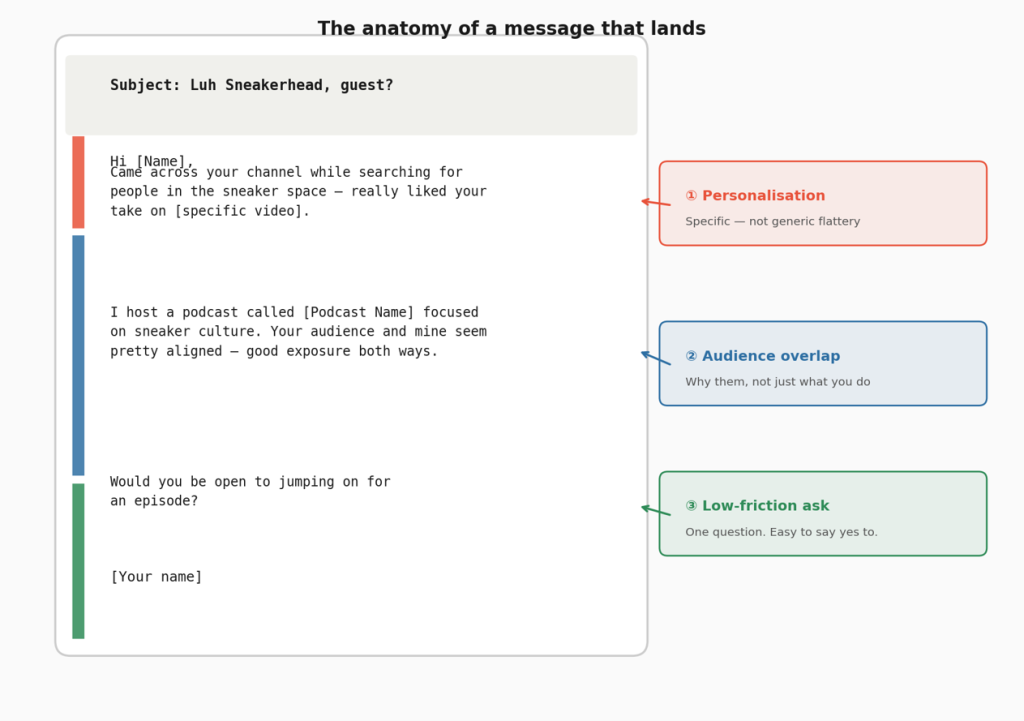
The three parts of an outreach message that lands
Don’t make them do the mental work of figuring out why it’s worth their time — tell them directly, then get out of the way.
Back to the sneaker example
In the last article, we used a sneaker podcast as our working example - a show focused on sneaker culture, the latest drops, and which pairs might become collectibles. We found Luh Sneakerhead on YouTube through Prospety: 10.4k subscribers, tight niche, clearly engaged audience.
Here’s what the outreach would actually look like:
-------------------------------
|
Subject: Luh Sneakerhead, guest? Hi {{Name}}, Came across your channel while searching for people in the sneaker space - really liked your take on {{specific video or recent drop you covered}}. I host a podcast called {{Podcast Name}} focused on sneaker culture - drops, collectibles, the stories behind the pairs people actually care about. Your audience and mine seem pretty aligned, and I think it could be good exposure both ways. Would you be open to jumping on for an episode? {{Your name}} |
-------------------------------
That’s it. Short, specific, makes the audience overlap point, ends with one easy question. UrAvg’Snkrs Guy with 100k subscribers gets the same structure - the personalisation line just changes.
The one follow-up
If they don’t reply, send one follow-up two days later. Keep it even shorter.
-------------------------------
|
Hi {{Name}}, Genuinely think you’d be a great fit for {{Podcast Name}} - your perspective on [topic] and the audience you’ve built around [channel] is exactly the kind of thing our listeners would value. Episodes are relaxed, conversational, usually around [X] minutes. Happy to work around your schedule if you’re open to it. {{Your name}} |
-------------------------------
After that, move on. Two touches is enough.
When you’re sending more than 20 emails a day
At low volumes, none of what follows matters much. But once you’re reaching out at scale - more than 20 emails a day, two things become important.
Spam words. Email service providers - Gmail, Outlook, and others are protecting their customers from promotional and unsolicited mail. Their filters scan for language that looks pushy or sales-driven. Words like “guaranteed,” “don’t miss out,” or “act now” can get you flagged before your message reaches anyone. Before you send at volume, run your copy through a spam checker like Mailmeteor. It highlights the exact words causing issues and explains why. Worth doing once before anything goes out.
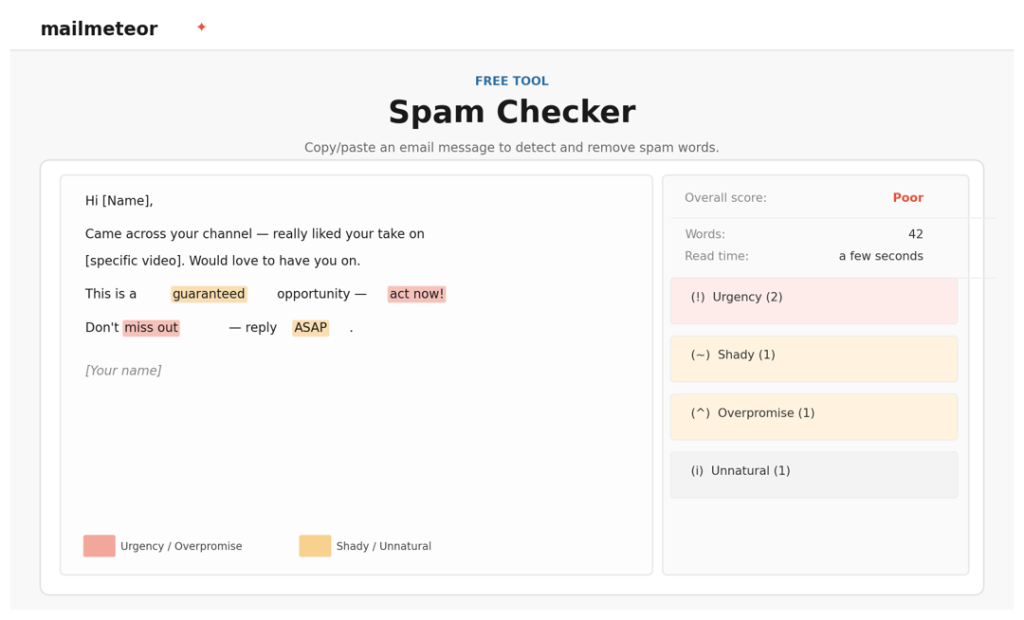
Mailmeteor flags problem words and tells you why they're an issue
Spintax. Even a well-written email sent to 500 people looks like a pattern to an algorithm. Spintax creates slight variations across each send, so no two emails are completely identical. The syntax looks like this for example:
-------------------------------
|
{{RANDOM | Hi | Hey | Hello}}, {{firstName}} |
-------------------------------
Each recipient gets a slightly different version, which helps avoid triggering spam filters and makes the outreach feel less templated. It’s a small thing that makes a real difference at scale. More on how to set this up along with the infrastructure needed to send at scale in the next article.
You only need one to land
What’s good about this approach is that you can reach out to people at real volume - big social profiles, creators with genuine audiences, people who would never stumble across your show on their own.
You only need one to land, and away you go. They share the episode. Their audience finds your show. The next pitch gets easier because now you have a name to drop and so It compounds.
What do they find when they Google your podcast?
There’s one more thing worth thinking about before you send anything. When a potential guest receives your outreach, they’re going to Google you and your show. That’s just what people do. And what they find in those first thirty seconds matters a lot.
If they land on a Spotify page, they’ve got a show description and a list of episodes. To really understand the tone, the values, the kind of guests you’ve had on they would need to sit and listen for 10 or 15 minutes. The majority won’t do that before deciding whether to reply your outreach.
A proper podcast website changes that. A potential guest can get a feel for the show, the brand, what it stands for, and who else has been on within a minute. That’s what tools like GoPod are built for. It turns your RSS feed into a proper web presence that is easily findable by potential guests and who are then more likely to say YES.